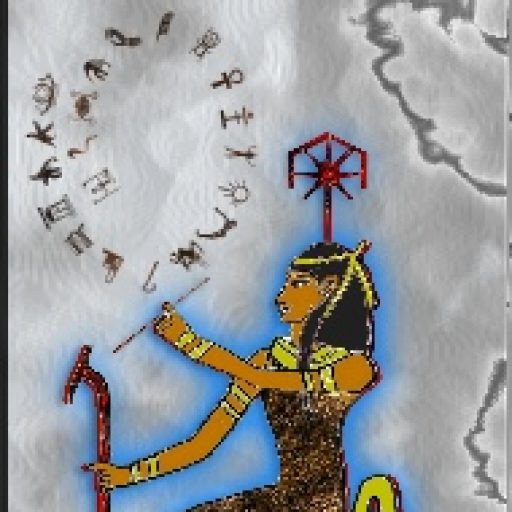

Here is a symbol that has remained almost unchanged for more than 4500 years!
Our contemporary letter takes up the top of the hieroglyph representing the god of disorder, war and unhealthy tricks!. It is inspired by his facial morphology in a great simplification from the face of the « Sethian Animal », a figuration of the hostile, even the infernal of ancient times. In linear, its identifier evokes its muzzle and ears.
The Proto-Canaanite offers the same aesthetic with a simplification of features, which can be found in the Phoenician, lamedh, which means « staff », which can be understood if we remember the nature of Set, a great lover of weapons of all kinds. The Aramaic and the Nabataean, lâmadh do not resemble the Phoenician except for the meaning « staff ».
The Archaic Greek takes up the name Phoenician, which becomes the lambda with an upside-down shape that leads to confusion with gamma.
He is the god “nearly king” with the head of an almost canine represented with all the divine attributes on a throne, cross of life and sceptre included, which could lead one to think that we are dealing with a good and calm character like his brother Osiris.
Seth, destruction and disorder, the great nonsense very much focused on violence. Irretrievable?
A vision to be contemplated with hindsight, because Seth represents internal, political and badly lived ambitions. He is the representative of the cyclical tumults of Egyptians to maintain their integrity, both territorial and ethical.
It is also observed that his name is regularly given to children, without them being systematically agitated and evil.

 Les Lettres Données / The Given Letters
Vous devez être connecté pour poster un commentaire.