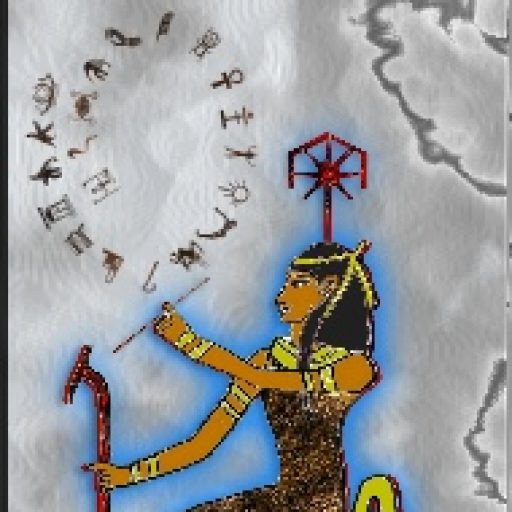

Osiris is the great Pharaoh God par excellence, creator of agriculture, manager of the floods of the Nile and a couple of times killed by his brother Set, drowned and then dismembered, rebuilt by his sisters Nephthys and Isis he will become the recipient of the throne of the afterlife.
He is often depicted as a king of Upper Egypt with a part of his body streaked.
Thus, the identifier of Osiris has a double meaning, the superimposition of broken lines, evokes both mummification strips and wavelets running on the Nile.
In Phoenician the “Mum” is the symbol for water, which becomes “Mim”, water in Aramaic and in Nabataean. If the graphic form is far away, the symbolic meaning has remained.
In archaic Greek, the Mum uses a spelling of waves, limits their number and places the jambs at the same level. This would remain unchanged during unification with Classical Greek.
The Etruscan is much closer to the Phoenician than to his Greek contemporary. Latin adopted practically the same approach as the Hellenes by producing the spelling which would later be the definitive M of classical Latin.
It is easy to remember its original meaning: M, for mummy.

 Les Lettres Données / The Given Letters
Vous devez être connecté pour poster un commentaire.