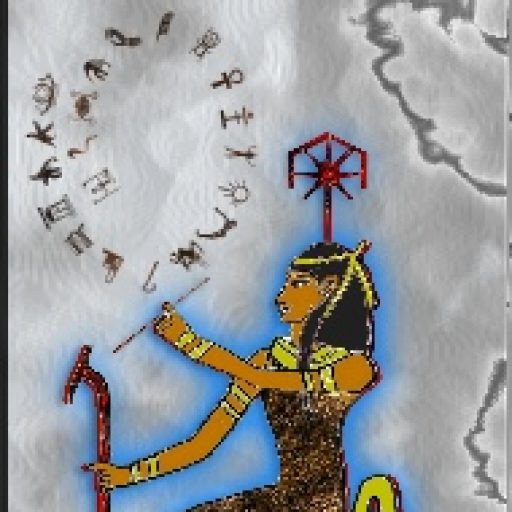
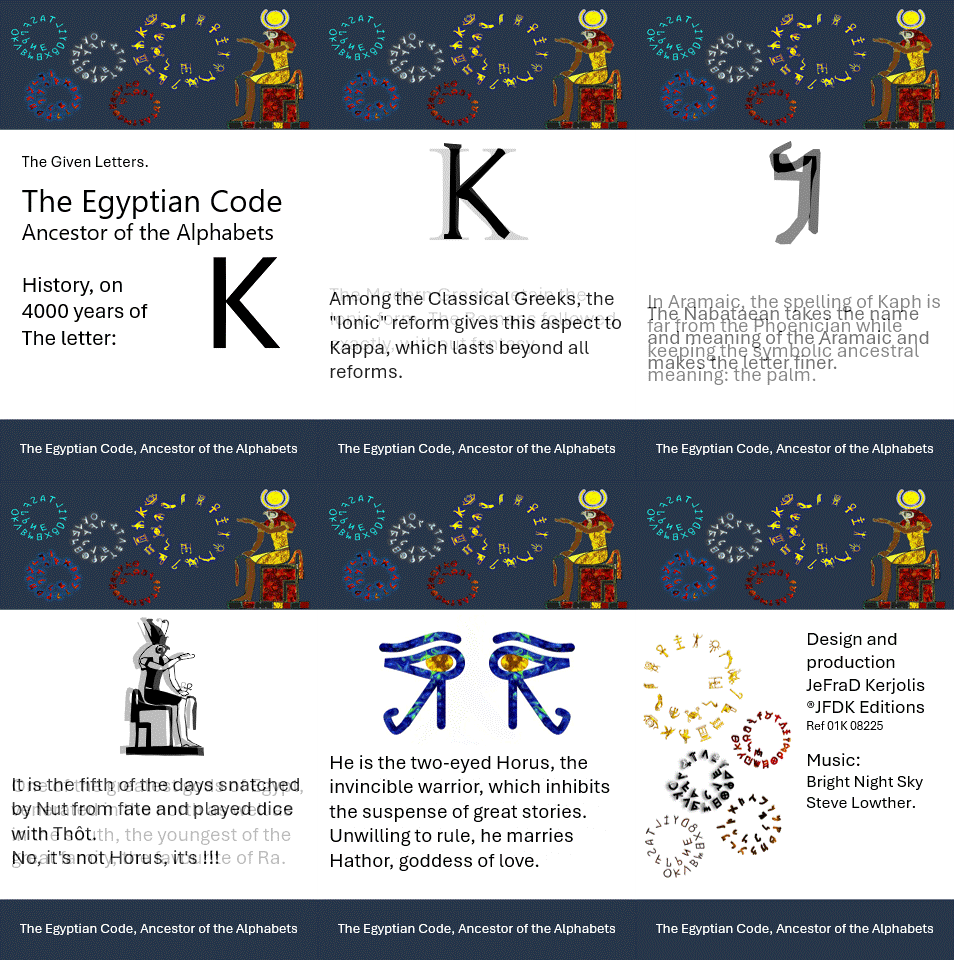
Haroëris, the Horus with two eyes, is like Rà a falcon with half-spread wings or a man with the head of a falcon, his arms open forming an angle.
One of its identifiers is the eye underlined by two lines, a spelling that will be celebrated for Horus, the Egyptians making it one of their mystical signs most loaded with meaning, including numerology.
In Proto-Canaanite the silhouette is refined and presents the particularities that will make it the inspiration for what becomes the Phoenician Kaph, symbol of the palm, or the hand.
In Aramaic the Kaph and in Nabataean is also the symbol for the palm. As with many transpositions since the Phoenician, if the meaning seems to be preserved, the graphics are perplexing even if we perceive the re-semblance of the top of the letter to its Phoenician inspiration.
A trend that is not found in Archaic Greek, since the ancient Kappa becomes the classical, i.e. an unchanged form.
The Etruscan transmitted the “mirror K” very similar to that of the Phoenician, which the Latins inverted before fixing it in a definitive shape following the Greek example.


Haroëris, a figure of fighting justice, is the warrior devot-ed to the cause of the great country, starting with the protection of Rà. He is inflexible, both towards what comes from the outside, and towards the intra-family dangers that Seth’s gloomy fantasies materialise.
 Les Lettres Données / The Given Letters
Vous devez être connecté pour poster un commentaire.